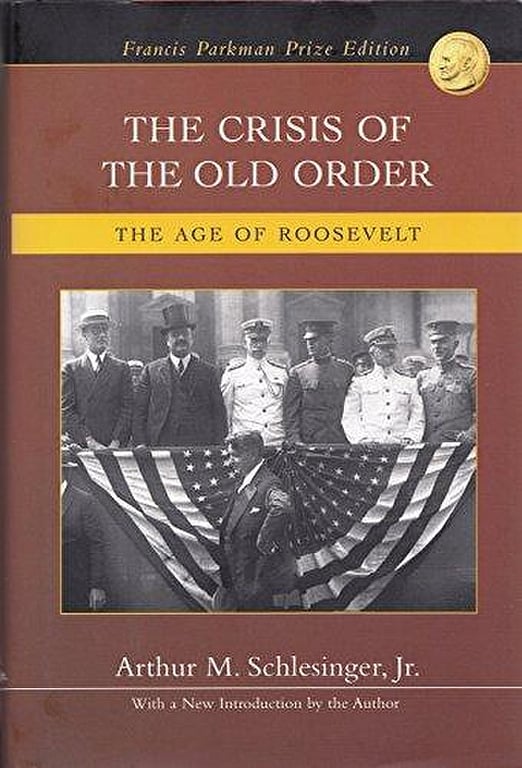
The Crisis of the Old Order The Age of Roosevelt, 1919-1933 - Schlesinger, Arthur Meier Jr.
The Crisis of the Old Order The Age of Roosevelt, 1919-1933 - Schlesinger, Arthur Meier Jr.
Couldn't load pickup availability
The Crisis of the Old Order The Age of Roosevelt, 1919-1933 by Schlesinger, Arthur Meier Jr.
Format: Hardcover with Dust Jacket
Published by History Book Club, 2002
The first of three volumes interpreting the political, economic, social, and intellectual history of the early years of the 20th century, specifically 1919-1933--from Versailles to Hitler, from Theodore Rosevelt to Herbert Hoover, from prosperity to near starvation, and finally from near despair to the new hope of Inauguration Day 1933. The main currents of thought and action, which reach a climax in the era of Franklin Roosevelt, had their source as far back as the Populist Movement of the 1890's. They can be traced back to Theodore Roosevelt's New Nationalism, in which government became a major instrument of reform, and to Wilson's New Freedom, a Jeffersonian concept soon to vanish in the necessities of war. Following these currents, listening tot he voices of those who led the stage or watched from the wings, we see the final burst of idealism in 1919, when for a moment the world did seem safe for democracy; then the better disillusionment of the Peace, the cynicism abroad and the witch hunts at home, the tired road to "normalcy." We see the outsiders looking in: the farmers whom prosperity has passed by, labor restless for a share in the wealth it had created, liberals losing their old faith, intellectuals bitter in a generation of complacent materialism, dreaming of a planned economy, many turning with apparent logic to Moscow. WE experience again the great crash of '29 as it was experienced a the time: the incredulity followed by bewilderment, and finally by the slow contagion of fear. As the Bonus Army was swept from the capital with fixed bayonets, as mortgages were foreclosed on the farms and breadlines formed in the cities, it appeared that reform was not enough, that what was needed was a new deal. The scene shifts to Hyde Park on the Hudson, to the boy growing up among the privileged "River families," After Gronton and Harvard, young Roosevelt showed his inbred sense of public service when he decided to run for the state legislature. From Albany the scene broadens as he moves to Washington to u undergo his first real test as Assistant Secretary of the Navy; then, after his trial by fire as victim of polio, there comes the governorship of New York. Then on the President of the United States.
Product image is for illustration purposes only and may not be an exact representation of the product offered for sale.